Full visibility, fewer delays: How unified scheduling improves construction
When a team in the paving division of a construction company plans its schedule for a job, it takes into account the crew available, the size of the job and how long it will take before the team will be ready to move on to the next assignment. But what happens if they arrive on site to find that the grading crew isn’t finished yet so the ground isn’t ready for paving? Or another paving job across town went long and there’s no equipment available for them?
When a construction company has dozens of divisions spread across hundreds of sites, these are all-too-common scenarios. Each division makes its own schedules, often with pen and paper, with no input from or insight into other divisions’ plans. When anything changes, it sends a ripple effect through the company, leaving everyone scrambling to manually update their schedules.
Palantir Foundry offers a better way, bringing together planning and scheduling for the whole company. One system, every division.
Siloed planning leads to more complication
Sarah Cavanagh, an Engagement Manager with Cavtera, says siloed, manual planning added both challenge and complication to already-complex projects for Thomas Cavanagh Construction, whose divisions follow a development from the ground up: site preparation, underground servicing, aggregates, paving and the buildings themselves.
“There’s lots of moving pieces all at once,” notes Cavanagh. “There can be different project managers, different teams, different services being provided, all at the same time.”
The result, says Cavanagh, was communication gaps between teams that made schedules harder to manage and made it tougher for the company to protect profit margins.
Paper schedules are out of date by the time they’re printed
One clear example of a communication gap was scheduling. Even though all the project teams were part of the same company, each one scheduled its own crews independently of every other division. More often than not, teams wrote schedules by hand and photocopied them to pass around. Even divisions that had gone digital were typically just using spreadsheets saved locally, with copies printed as needed.
Often, by the time everyone had a copy of the schedule, it was already out of date because the weather or some other factor had caused a delay. When that happened, the whole schedule had to be manually rewritten and reissued — wasting even more time.
“When you were a kid and you dreamed about working in construction, you never dreamed about actually using Excel spreadsheets all day,” says Cavanagh.
On top of that, other divisions weren’t always informed when a schedule changed. As a result, a crew could mobilize for a stage that wasn’t actually ready. Lost productivity like that adds up fast across a construction project.
“Planning in this industry is huge,” says Cavanagh. “If you can’t plan, nobody’s going to want to work with you.”
How Palantir Foundry improves construction planning and scheduling
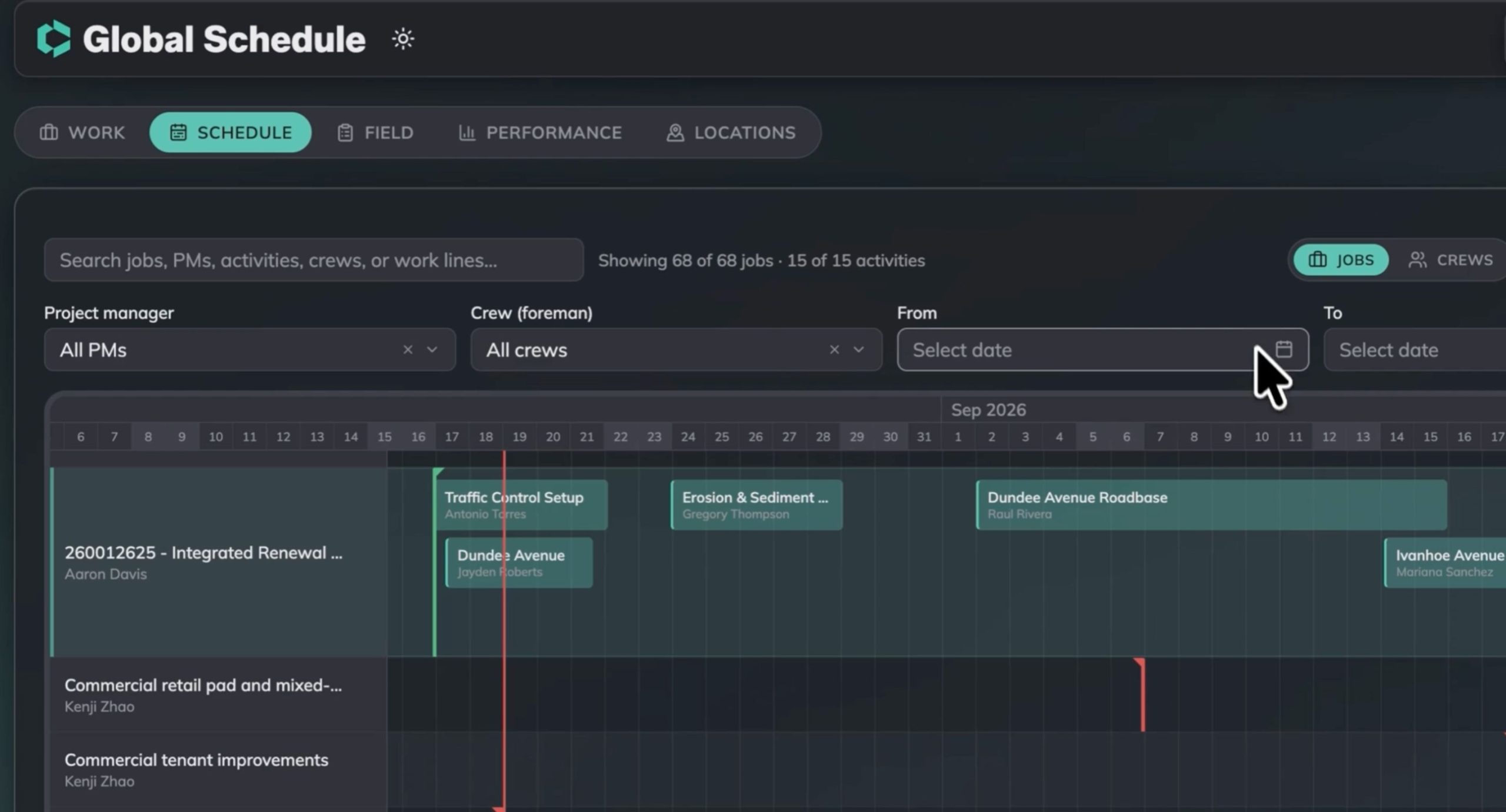
With Palantir Foundry, all the core functions of a construction company, including scheduling, come together in one unified operating system. For Thomas Cavanagh Construction, moving its scheduling process to Foundry led to immediate improvements.
Projects are now planned out from beginning to end in the same view, no matter how many different teams or divisions are involved. Everyone sees the same data, with changes visible to everyone right away, so schedules can be adjusted easily if necessary. No more manual shifting of every date along the timeline. No more wasted days.
The benefits of unified scheduling for construction companies
Unifying planning and scheduling within Foundry provides a global view of an entire job, from the pipe-layers to the grading crew to the paving crew, all in one place. This kind of total communication, from office to field labourer, delivers several clear benefits to construction companies:
- All teams get better access to information about their own work so they can prepare for what’s coming up, as well as other divisions’ work and how it will affect their own.
- Operations can more effectively allocate resources like labour and equipment, keeping projects moving and avoiding costly idle time.
- Companies can improve productivity by letting technology handle low-value work so skilled people do the work they specialize in.
- The applications we build in Foundry are designed to work the way field crews need them to instead of forcing crews to work around back office systems.
One system for every division
Palantir Foundry supports far more than just scheduling. Applications built on the platform can solve communication breakdowns throughout an entire company. For example, by adopting digital timecards built in Foundry, construction companies can eliminate the hassle of filling out, submitting and transferring paper timecards from the field to the office, providing more convenience, better data, and improved transparency into labour and payroll.
That’s all part of the unified, company-wide view Foundry provides. This shared view makes individual teams more productive by avoiding downtime so they can get more done. It also makes projects as a whole go more smoothly, supporting the company’s ability to deliver on time and on budget.
“By providing a global schedule for everything, that means everything is scheduled in one place, everyone has full visibility into the communication and the operations are streamlined,” says Cavanagh.